| Fun facts about Connecticut Fire History – The Norwalk Conflagration of 1858
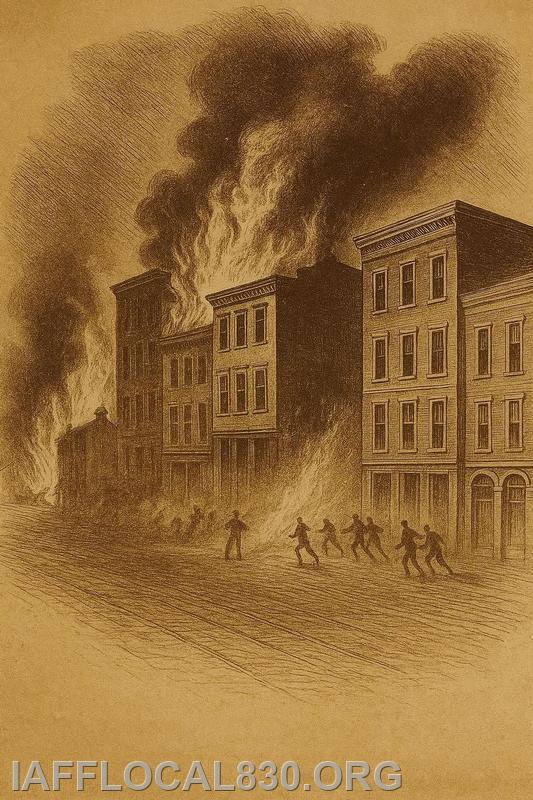
Less than eighty years before the next major blaze would strike the city, Norwalk experienced a devastating fire that forever changed its approach to fire protection. On November 19, 1858, a fire broke out in a defective chimney inside the Terrell & Down’s cabinet shop. The flames spread quickly through the business district at the head of the harbor at Wall and Commerce Streets, consuming tightly packed wooden buildings and driven by wind.
By the time the fire was finally stopped, at least sixteen buildings were destroyed, including the railroad depot, the Isaacs block of office buildings, a lumberyard, grocery stores, and several commercial structures.
At the time, the borough owned only a small hand-pumped engine and had no organized or trained fire company to operate it. The lone hand pump was no match for the spreading fire, forcing authorities to telegraph nearby cities for assistance. Danbury responded by loading two hose wagons and firefighters onto a train, rushing south to help, but they arrived too late. Telegraph attempts to reach Bridgeport and Stamford failed, leaving Norwalk to battle the fire largely on its own.
Four days later, on November 23, 1858, the Norwalk Gazette ran the headline: “Great Conflagration in Norwalk! Sixteen Buildings in Ashes! Property to the Amount of $100,000 Destroyed.” The paper sharply criticized the town’s lack of fire preparedness, noting the embarrassment of relying on “nothing but a little garden engine” during such a major disaster. Other regional newspapers echoed these frustrations, and public pressure rose quickly.
The fire became a turning point for the community. The destruction, the criticism, and the overwhelming realization of how vulnerable the town had become directly led to the formation of Norwalk’s first volunteer fire companies—marking one of the most important shifts in its fire-service history.
Prior to this fire, the first major fire in the history of Norwalk occurred on July 10th, 1779. When British troops under General William Tryon ferried across Long Island Sound and landed at Calf Pasture Beach. From there, they moved inland up both sides of the harbor, skirmishing with local militia along the way. After a battle at the bottom of West Rocks hill, the British withdrew back to their boats, setting fire to the town. Destroyed in the fire were 130 homes, 40 shops, 100 barns, five ships, two churches, flour mills, and salt works.
Today, the now City of Norwalk Fire Department is a career fire department consisting of 136 firefighters and fire officers, deployed into 4 shifts (platoons) with a daily staffing of 34 firefighters manning 5 fire stations throughout the City. Front line apparatus consists of 5 Engine Companies, 2 Truck Companies, 1 Rescue Company, and a command car (Shift Commander) providing fire suppression, EMS, technical rescue, hazardous materials expertise as well as maritime fire protection services to the City of Norwalk.
The department also contains 12 staff personnel consisting of the Fire Marshal's Office, Training Division, Apparatus Maintenance Division, Office of Emergency Management, the Fire Chief, and 2 Assistant Chiefs, respectively.
(Please Note: The Fire Chief, Assistant Fire Chief's, Apparatus Maintenance Division, and Emergency Management are not represented by IAFF Local 830) |